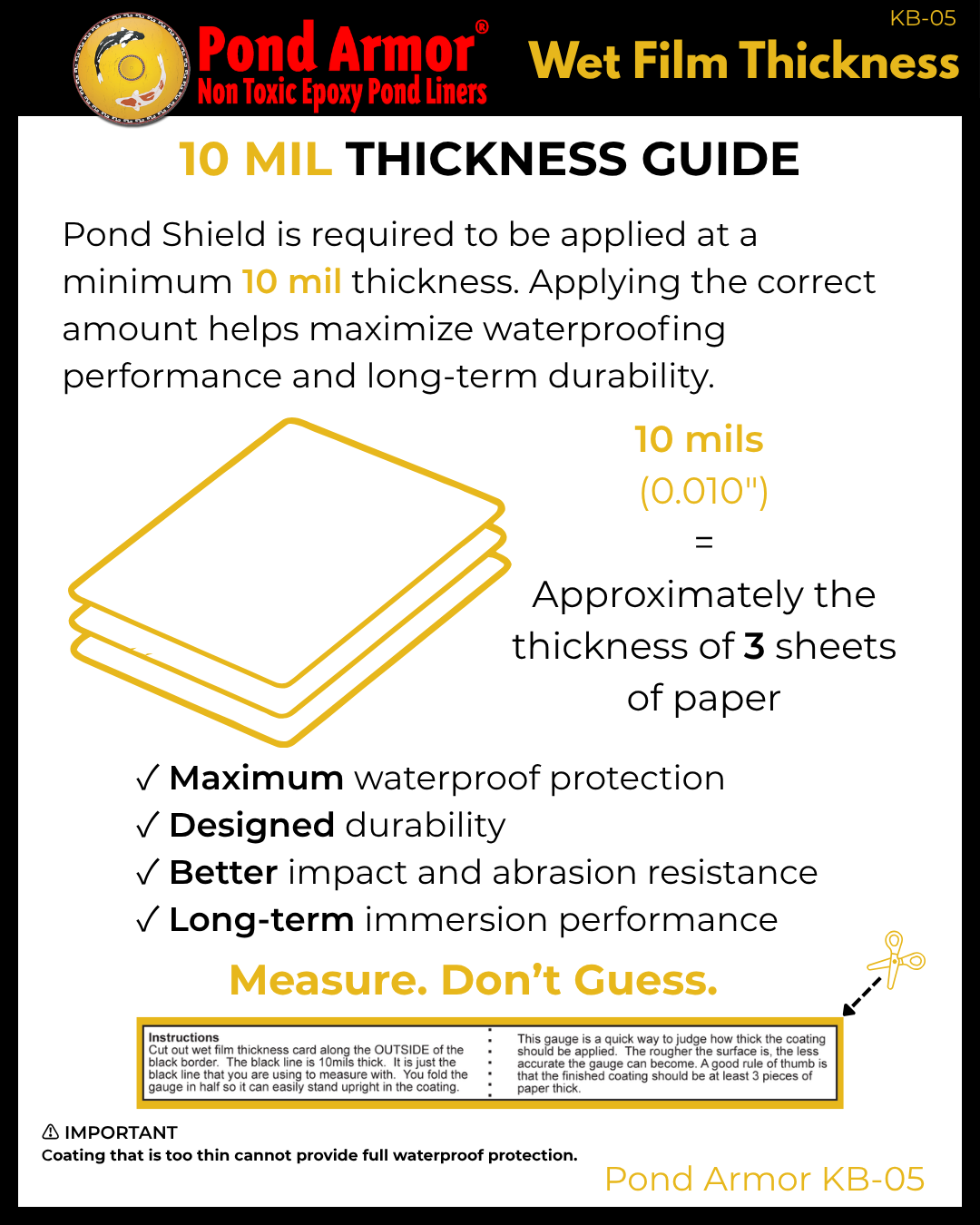
Applying Pond Shield evenly is only part of creating a successful waterproof coating. The coating must also be applied at the proper thickness. Pond Shield should be applied to a minimum finished thickness of 10 mils (0.010 inch) to provide the performance the coating is designed to achieve.
This KB-05 Pond Shield wet film thickness guide explains what 10 mils looks like, why coating thickness matters, and how to check your application while the coating is still wet. If you have not already reviewed the application process, start with KB-04: How to Apply Pond Shield Epoxy Coating.
What Is the Correct Pond Shield Thickness?
The finished Pond Shield coating should be a minimum of 10 mils thick. A mil is one-thousandth of an inch, so 10 mils equals approximately 0.010 inch.
That may be difficult to visualize while working on a pond, fountain, aquarium, waterfall, or other water feature. A simple reference is to think of approximately three sheets of standard copy paper stacked together. This provides a useful visual comparison for the target thickness, but it should not replace an actual wet film thickness measurement whenever a gauge is available.
It is important to remember that simply covering the substrate is not enough. A surface can appear completely coated while the Pond Shield layer is still too thin.
Why the 10 Mil Thickness Matters
Pond Shield is a waterproof epoxy coating rather than ordinary paint. The coating creates a continuous barrier between the prepared substrate and the water it contains. Applying the material at the proper thickness helps the coating provide the waterproofing performance, durability, and protection for which it was designed.
When Pond Shield is spread too thin, the surface may still look coated even though there is not enough material present. Thin areas can also be easier to overlook when the underlying substrate is similar in color or when lighting makes the wet coating appear more uniform than it actually is.
During application, watch for transparent areas, visible substrate, patchy sections, or areas that appear noticeably thinner than the surrounding coating. As discussed in KB-04: Application Techniques, the wet surface should have a smooth, even and consistent appearance.
Use a Wet Film Thickness Gauge
The most reliable way to check coating thickness during application is with a wet film thickness gauge. The gauge allows you to check the depth of the freshly applied Pond Shield before it cures.
Take measurements while the coating is still wet and workable. Checking several locations across the project is more useful than measuring only one area, especially when coating vertical surfaces, textured substrates, corners, transitions, or other areas where material thickness can vary.
If a measurement shows that the coating is below the required thickness, correct the area while the material is still workable whenever possible. Continue checking your work as you move through the project rather than waiting until the entire surface has been coated.
Use Three Sheets of Paper as a Visual Reference
If you are trying to understand what 10 mils looks like, approximately three sheets of standard copy paper provide an easy visual reference. Stack three sheets together and look at their combined edge thickness.
This comparison is particularly useful before beginning the project because it gives you a physical sense of how substantial the coating should be. However, the paper comparison is only a visual aid. Use the wet film thickness gauge to verify the actual coating whenever possible.
Smooth and Rough Surfaces May Apply Differently
The amount of Pond Shield required to achieve the proper thickness can vary depending on the surface. Smooth surfaces make it easier to distribute material evenly and may allow the required thickness to be achieved in a single coat.
Rough, porous, or highly textured surfaces contain peaks, valleys, pores, and irregularities that consume additional material. This is one reason actual coverage can differ from theoretical square-foot estimates.
Do not compensate by stretching the coating thinner. The objective is to maintain the required coating thickness across the entire prepared surface.
Building Additional Thickness
Pond Shield may be applied thicker than the minimum when a project requires additional material. However, the complete Pond Shield instructions recommend building additional thickness through multiple coats rather than applying one excessively heavy coat.
Multiple coats can provide greater control over the application and allow the coating to cure more efficiently than an unnecessarily heavy single application. Always follow the current Pond Shield instructions for recoating times and surface preparation between coats.
Do Not Judge Thickness by Coverage Alone
Published coverage figures are useful for estimating the amount of Pond Shield needed for a project, but they should not be used as a reason to spread the coating farther than the required thickness allows.
Surface texture, porosity, application tools, technique, and the amount of material left in containers can all affect real-world coverage. If the project uses more material than expected, check the surface and application technique rather than reducing coating thickness to reach a predetermined square-foot number.
For additional information about coverage and application conditions, review the Pond Shield Frequently Asked Questions.
Check Thickness Before Moving On
As you apply Pond Shield, periodically stop and verify the wet film thickness. Look across the surface from different angles, check areas where material may have been spread thin, and use the wet film thickness gauge at multiple locations.
Once the coating has been applied at the proper thickness, the next step is a careful inspection of the completed surface. Inspection helps identify pinholes, thin areas, missed sections, bare substrate, puddles, runs, and other irregularities before the water feature is put into service.
Continue Through the Pond Shield Knowledge Base
KB-05 builds on the application techniques covered in KB-04. Once you have verified that Pond Shield has been applied at the proper thickness, continue to KB-06: Inspection to learn how to methodically check the coated surface before adding water.