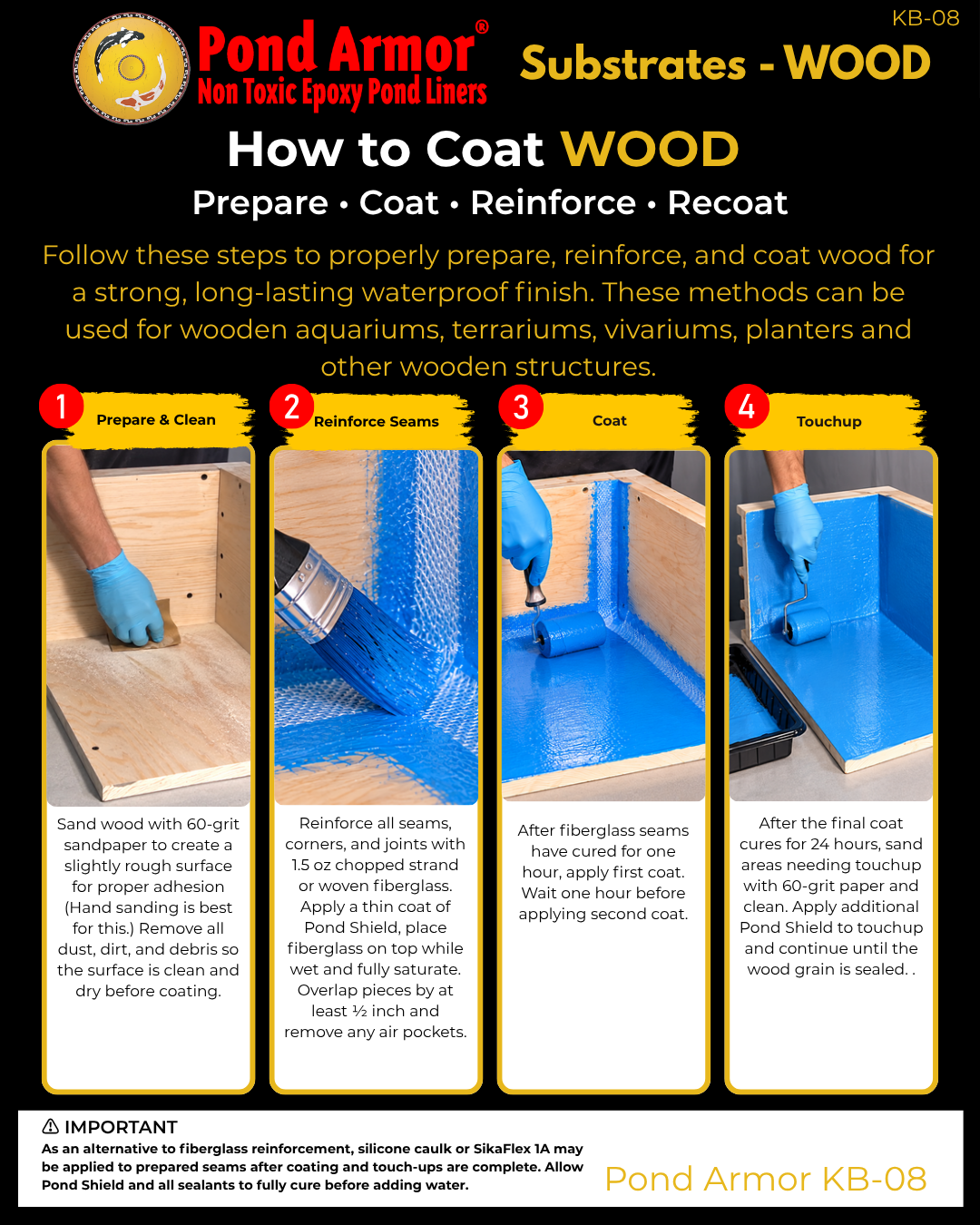
How to Coat Wood with Pond Shield Epoxy
Wood can be used to construct ponds, water features, and other projects that require a waterproof surface. However, unlike concrete, wood can expand, contract, and move in response to changes in moisture and temperature.
When coating a wooden structure with Pond Shield epoxy, proper surface preparation and reinforcement are especially important. Particular attention should be given to joints, corners, and seams where movement or gaps may occur.
This guide covers preparing wood, reinforcing vulnerable areas, applying Pond Shield, and inspecting the finished coating.
1. Preparing Wood for Pond Shield
Begin with a structurally sound wooden surface. All wood should be clean, dry, and free of dust, oils, loose paint, and other contaminants that could interfere with adhesion.
Sand the wood using approximately 60-grit abrasive to create a suitable mechanical profile for the epoxy coating. Remove all sanding dust before beginning the application process.
Inspect the structure for gaps, exposed fasteners, damaged areas, and joints requiring additional attention. Complete any necessary repairs before applying Pond Shield.
2. Reinforcing Seams and Corners
Seams and corners require special attention when waterproofing wooden structures. Unlike a continuous concrete surface, adjoining pieces of wood may move independently.
Fiberglass reinforcement can help strengthen these areas and provide additional support beneath the epoxy coating.
- Confirm that all seams and adjoining surfaces are properly prepared and free of contamination.
- Mix a small batch of Pond Shield according to the manufacturer's instructions.
- Apply Pond Shield to the seam or corner where reinforcement will be installed.
- Embed the specified chopped-strand or woven fiberglass reinforcement into the wet coating.
- Work the material into the reinforcement to eliminate trapped air and ensure proper saturation.
- Inspect the reinforced area before proceeding with the remaining coating application.
Depending on the structure, additional seam preparation or an appropriate sealant may be required. Confirm compatibility and the recommended sequence before application.
⚠ Important
Fiberglass reinforcement supports properly constructed seams and corners, but it is not a substitute for a structurally sound wooden assembly. Excessive movement, unsupported joints, or inadequate surface preparation can compromise a waterproof coating.
3. Mixing Pond Shield Epoxy
Pond Shield is a two-component epoxy coating that must be measured and mixed according to the manufacturer's instructions.
Follow the specified mixing ratio and thoroughly combine both components before application. Only mix the amount of material that can be applied within the available working time, generally approximately 20–30 minutes under typical conditions.
For detailed mixing procedures, review KB-03: Pond Shield Mixing Procedures .
4. Applying Pond Shield to Wood
Once the surface and reinforced areas are prepared, Pond Shield can be applied to the wooden structure.
Work systematically to achieve a smooth, consistent coating without leaving thin spots, pinholes, or uncoated areas.
Apply Pond Shield using an appropriate brush, roller, or other manufacturer-approved application method.
Maintain a minimum wet film thickness of approximately 10 mils, equivalent to roughly three sheets of paper.
Where multiple coats are required, follow the manufacturer's specified recoat window. The working sequence for this wood guide calls for coating reinforced areas first, followed by full coating applications at approximately one-hour intervals under suitable conditions.
Do not rely on elapsed time alone. Temperature, environmental conditions, and the condition of the previous coat can influence recoating requirements.
Learn more about achieving the correct coating thickness in KB-05: Pond Shield Wet Film Thickness Guide .
5. Inspecting the Finished Coating
Once the coating has been applied, carefully inspect the entire wooden structure.
Pay particular attention to seams, corners, edges, fasteners, and other areas where coating thickness may be inconsistent.
Look for pinholes, thin areas, exposed reinforcement, missed sections, or surface defects that may require additional attention.
If touch-ups are necessary, prepare the affected area according to the manufacturer's instructions before applying additional Pond Shield.
For more information, visit KB-07: Pond Shield Touch-Up & Repair .
6. Allowing the Coating to Cure
Pond Shield must be allowed to cure completely before the finished surface is placed into service or exposed to standing water.
Under suitable conditions, the standard minimum cure period is approximately 24 hours. Cooler temperatures or other environmental conditions may affect curing.
The finished coating should feel smooth, dry, and plastic-like rather than tacky. Follow the complete manufacturer instructions before filling the structure with water.
⚠ Important
Pond Shield provides a waterproof coating, but it cannot compensate for structural movement, inadequate reinforcement, improper surface preparation, or unsuitable construction. Always confirm that the wooden structure is appropriate for its intended application.
Continue Through the Pond Shield Knowledge Base
Explore additional resources to help you prepare, apply, inspect, and maintain your Pond Shield epoxy coating.
- KB-03: Pond Shield Mixing Procedures
- KB-05: Pond Shield Wet Film Thickness Guide
- KB-07: Pond Shield Touch-Up & Repair